Upper and Mid Back Exercises, Phase 2: Control and Mobility
Clinical content from the Auto Injury Chiropractic home rehab program. Final clinical reviewer: Dr. Seth Hill, DC. How we review content
Phase 2 builds on Phase 1 and works on mobility through your mid back. The foam roller is your main tool this phase. Start after your provider checks your progress from the previous phase. If you are our patient, your provider will show you any new exercise.
These exercises are for education. After a car accident or injury, get checked by a provider before you start. They do not replace an exam.
How oftenDaily for one phase. Each session takes about 10 to 15 minutes.
What "no pain" meansEach exercise should not cause sharp pain. A small stretch is okay. If something hurts, stop. Try a smaller motion. If it still hurts, skip that one and tell your provider.
Do not use these exercises if:
You may have a broken bone in your upper or mid back. Wait until your provider checks your scans and says it is safe.
You have any of the warning signs listed on this page.
A new symptom you did not have at your first visit.
You cannot control your bladder or bowels.
Other
Fever, chills, or weight loss with your pain.
A new injury to the area since your first visit.
If you are one of our current patients, call the clinic and inform your provider right away, or seek emergency care right away. For a life-threatening emergency, call 911.
What comes next
Your provider decides when you move to the next phase.
Scan for this program online: autoinjurychiropractic.com/rehab/mid-back/phase-2/
Upper and Mid Back Exercises, Phase 2: Control and Mobility
MB-2 · Version 1.0, October 2026
Phase 2 builds on Phase 1 and works on mobility through your mid back. The foam roller is your main tool this phase. Start after your provider checks your progress from the previous phase. If you are our patient, your provider will show you any new exercise.
How often: Daily for one phase. Each session takes about 10 to 15 minutes.
What "no pain" means: Each exercise should not cause sharp pain. A small stretch is okay. If something hurts, stop. Try a smaller motion. If it still hurts, skip that one and tell your provider.
Do not use these exercises if:
You may have a broken bone in your upper or mid back. Wait until your provider checks your scans and says it is safe.
You have any of the warning signs listed on this page.
Stop and get help
Nerves or brain: Numb or tingly arms, hands, face, or legs. Weak grip, weak arms, or weak legs. Slurred words or face droops. New vision changes or double vision. Sudden loss of balance.
Heart or breathing: Chest pain or trouble breathing. Heart beating fast or skipping. You pass out or almost pass out.
Getting worse: Pain wakes you from sleep and will not stop. Pain gets worse each day. A new symptom you did not have at your first visit. You cannot control your bladder or bowels.
Other: Fever, chills, or weight loss with your pain. A new injury to the area since your first visit.
If you are one of our current patients, call the clinic and inform your provider right away, or seek emergency care right away. For a life-threatening emergency, call 911.
Scan for photos and the demonstration video: autoinjurychiropractic.com/rehab/exercises/foam-roller-thoracic-extension/#mb-2
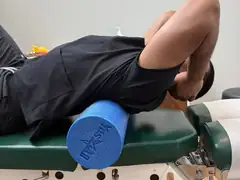
1. Foam Roller Thoracic Extensions
Dose: 1 time a day, 60 to 90 seconds at each of 3 spinal levels You need: A foam roller
How to do it
Lie on your back. Place the foam roller across your spine just below your shoulder blades. Knees bent, feet flat.
Cross your arms over your chest, or rest hands lightly behind your head for neck support. Do not pull your head.
Slowly let your upper back drape over the roller. Breathe slow and easy. Do not force the stretch. Let gravity do the work.
Hold this position for 60 to 90 seconds. Keep breathing relaxed. Tissue takes time to release.
Roll the foam roller 1 to 2 inches up your back to a higher level. Hold another 60 to 90 seconds.
Roll up once more to a third level. Hold another 60 to 90 seconds.
Slowly roll off to one side to come up. Do not sit straight up.
Too hard? Try this: If the roller feels too firm, use a rolled-up towel or a softer roller. Or shorten the hold to 30 seconds at each level and build up over the phase.
Too easy? Try this: Slowly extend your arms overhead while in the position to deepen the stretch. Or hold each level for 2 full minutes.
Stop right away if
Sharp pain in your spine.
Pain, numbness, or tingling down your arms or legs.
Chest pain or trouble breathing.
If you are one of our current patients, call the clinic and inform your provider right away, or seek emergency care right away. For a life-threatening emergency, call 911.
Scan for photos and the demonstration video: autoinjurychiropractic.com/rehab/exercises/thread-the-needle/#mb-2
2. Thread the Needle
Dose: 2 times a day, 8 reps each side You need: A mat or carpeted floor
How to do it
Get on your hands and knees. Hands under shoulders, knees under hips.
Slide your right arm under your left arm and across your body, palm up. Let your right shoulder come down to the floor.
Rest your right cheek on the floor if comfortable. Keep hips level over your knees.
Hold 2 seconds. Slowly return to the starting position.
Do 8 reps. Switch sides and do 8 on the other side.
Too hard? Try this: If your shoulder cannot reach the floor, go only as far as comfortable. Or do it from a forearm position instead of hands.
Too easy? Try this: Hold the threaded position for 5 seconds. Or do it slow with a 3-second twist up and 3-second thread under.
Stop right away if
Sharp pain shooting down your arms.
Numb or tingly hands.
Dizzy.
If you are one of our current patients, call the clinic and inform your provider right away, or seek emergency care right away. For a life-threatening emergency, call 911.
Scan for photos and the demonstration video: autoinjurychiropractic.com/rehab/exercises/prone-y-t-w/#mb-2
3. Prone Y and T
Dose: 1 time a day, 10 reps each letter You need: A mat or carpeted floor
How to do it
Lie face-down on a mat. Forehead on a small towel so you can breathe.
Y: arms straight out above your head in a Y shape, thumbs up. Lift arms slightly off the floor. Hold 2 seconds. Lower. Do 10.
T: arms straight out to the sides making a T, thumbs up. Lift slightly. Hold 2 seconds. Lower. Do 10.
Lift only a little. Form matters more than height.
Keep your head and neck relaxed throughout.
Too hard? Try this: Skip the lift. Just hold each position with arms resting on the floor for 5 seconds. Do 10 each letter.
Too easy? Try this: Add 3-second holds at the top of each lift. Or hold a small soup can in each hand.
Stop right away if
Sharp pain in your neck, back, or arms.
Numb or tingly arms or hands.
Trouble lifting your head to breathe.
If you are one of our current patients, call the clinic and inform your provider right away, or seek emergency care right away. For a life-threatening emergency, call 911.
Scan for photos and the demonstration video: autoinjurychiropractic.com/rehab/exercises/seated-thoracic-rotation/#mb-2
4. Seated Rotation with Reach
Dose: 2 times a day, 8 reps each side You need: A chair
How to do it
Sit up tall in a chair. Feet flat on the floor.
Hold your right arm straight out in front of you at shoulder height.
Slowly rotate your trunk to the right while keeping your right arm reaching out. Follow your hand with your eyes.
Hold 2 seconds at the end. Return slowly to center.
Do 8 each side.
Too hard? Try this: Keep hands in your lap and just do the rotation without the reach.
Too easy? Try this: Hold for 5 seconds at the end. Or add a light dumbbell or water bottle in the reaching hand.
Stop right away if
Sharp pain shooting down your back.
Numb or tingly limbs.
Dizzy when rotating.
If you are one of our current patients, call the clinic and inform your provider right away, or seek emergency care right away. For a life-threatening emergency, call 911.
MB-2 · Version 1.0, October 2026 · autoinjurychiropractic.com/rehab/mid-back/phase-2/
Manage Consent
To provide the best experiences, we use technologies like cookies to store and/or access device information. Consenting to these technologies will allow us to process data such as browsing behavior or unique IDs on this site. Not consenting or withdrawing consent, may adversely affect certain features and functions.
Functional
Always active
The technical storage or access is strictly necessary for the legitimate purpose of enabling the use of a specific service explicitly requested by the subscriber or user, or for the sole purpose of carrying out the transmission of a communication over an electronic communications network.
Preferences
The technical storage or access is necessary for the legitimate purpose of storing preferences that are not requested by the subscriber or user.
Statistics
The technical storage or access that is used exclusively for statistical purposes.The technical storage or access that is used exclusively for anonymous statistical purposes. Without a subpoena, voluntary compliance on the part of your Internet Service Provider, or additional records from a third party, information stored or retrieved for this purpose alone cannot usually be used to identify you.
Marketing
The technical storage or access is required to create user profiles to send advertising, or to track the user on a website or across several websites for similar marketing purposes.