
Knee and Ankle, Phase 1 · Exercise 5 of 5 KA-1 #5
Calf Self-Release (optional)
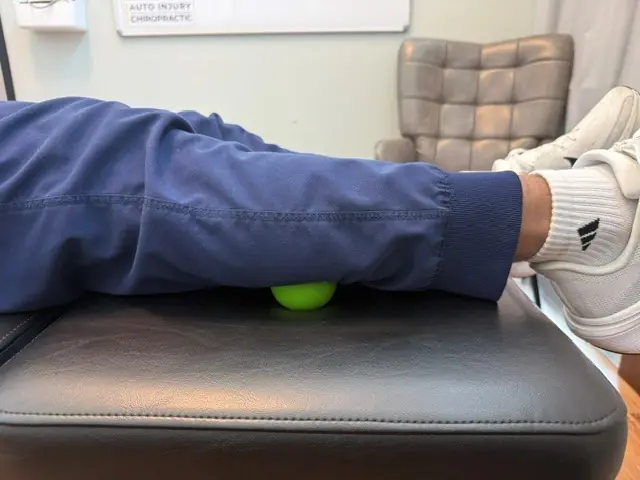
Release tight calf muscles
Demonstration video: Calf Muscle Release With Ball and Foam Roller - Gastrocnemius and Soleus (Physical Therapy 101). Follow the steps on this page if the video differs.
Photos
Why it helps
The calf muscles often get tight after a car accident from holding the brake pedal hard at impact, then from days of less activity. Slow pressure with belly breathing helps the muscle release without forcing anything.
How to do it
- Sit on the floor (or on a firm bed) with legs out in front of you. Place the ball or roller under one calf, about halfway between the knee and the heel.
- Slowly lift your hips so some of your body weight presses through the calf onto the ball.
- Find a spot that feels tender but NOT sharp. Stay on that spot.
- Belly breathe slow and deep for 60 to 90 seconds. Let the muscle slowly release.
- Slowly come off. Move the ball to a different spot if needed. Switch legs.
Too hard? Try this
Use a softer ball or a folded towel. Or shorten the time to 30 seconds and build up.
Too easy? Try this
Slowly bend and straighten the ankle 5 times while staying on the spot. Or use a firmer ball.
Common mistakes
- You press into sharp pain, NOT just tender.
- You hold your breath instead of belly breathing.
- You go too long and the calf gets MORE sore.
- You ignore signs of redness, warmth, or swelling.
You should feel
- Deep, dull pressure on the tender spot.
- Slow, easy belly breathing.
- The calf gradually softening.
You should not feel
- Sharp pain.
- A "rubber band snapping" feeling.
- Numbness in the foot or toes.
Stop right away if
- Calf pain with redness, warmth, or swelling (possible blood clot).
- Numb or tingly foot or toes.
- Sharp pain that does NOT improve when you stop.
If you are one of our current patients, call the clinic and inform your provider right away, or seek emergency care right away. For a life-threatening emergency, call 911.
Research behind this program
- Cheatham SW, Kolber MJ, Cain M, Lee M. Int J Sports Phys Ther, 2015. PMID 26618062
Auto Injury Chiropractic
Same-day visits at three clinics
Oregon City
1404 Molalla Ave
Oregon City, OR 97045
Mon to Thu 9:00am to 6:00pm
Fri 9:00am to 1:00pm
Milwaukie
13152 SE Rusk Rd
Milwaukie, OR 97222
Mon to Thu 9:00am to 6:00pm
Fri 9:00am to 1:00pm
Troutdale
233 E Columbia River Hwy
Troutdale, OR 97060
Mon to Thu 9:00am to 6:00pm
Fri 9:00am to 1:00pm